

How tall is 62 inches in feet and inches?
62 inches is exactly 5 feet 2 inches.
Simple math. But let’s be honest most of us don’t think in inches.
You’re probably here because you’re trying to picture what that really means.
Maybe you’re shopping for furniture.
Maybe it’s your child’s height on a growth chart.
Or you’re just trying to visualize someone who said they’re 62 inches tall.
Whatever the reason, you deserve more than just a number.
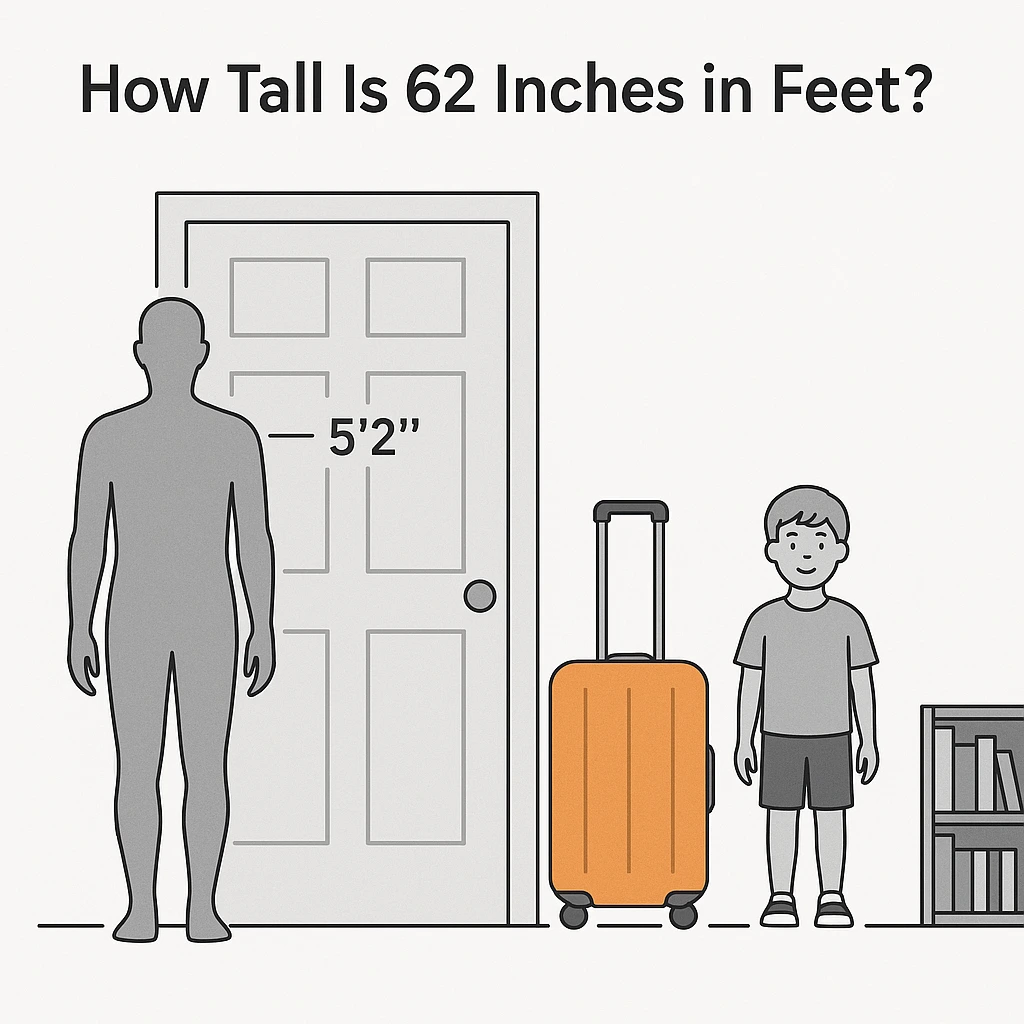
5’2″ is about the height of a standing carry-on suitcase, a fridge drawer, or actress Maisie Williams (Arya from Game of Thrones).
That’s where this guide steps in.
It doesn’t just show you a calculation.
It shows you what 62 inches looks like, beside real people and objects you know.
A Quick Story
Years ago, I ordered a 62-inch bookshelf online.
In my head, it sounded tall.
Eye-level, maybe even higher.
When it arrived, I stood next to it… and it barely reached my chin.
(I’m 5’7″.)
That was the day I learned something obvious but often ignored:
Size without context is confusing.
And that’s why this article exists to give you more than a number. To give you scale.
By the end, you’ll not only know how tall 62 inches is.
You’ll see it. Feel it. Use it.
And if you’re converting to metric?
You’re covered there too.
How to Convert 62 Inches to Feet (Without Overthinking It)
How do you convert inches to feet manually?
To Convert inches to feet manually, Just divide by 12.
Let’s make this simple.
One foot equals 12 inches.
That’s the only number you need to remember.
To find out how many feet are in 62 inches, divide 62 by 12.
62 ÷ 12 = 5.1666…
Now, here’s the human-friendly version:
That means you have 5 full feet, with a little extra left over.
To figure out how much is left, just multiply the decimal:
0.1666 × 12 = 2
So, 62 inches = 5 feet 2 inches.
Pro Tip: Quick Conversion Formula
Inches ÷ 12 = Feet
If you want feet + inches, multiply the decimal back by 12.
My Shortcut Trick
I once built a closet wall at home as a weekend DIY project.
Nothing fancy just wanted a divider to create more storage.
The plan was for it to be exactly 5 feet tall.
I measured. Marked. Cut. Screwed everything in.
Then stepped back to admire the work.
Something felt… off.
Turns out, I had misread the tape.
I built it 5 inches too short.
That small mistake made the entire space feel awkward.
It looked more like a half-wall than a proper divider.
Since then, I follow a simple rule every time I measure:
Divide by 12 to get feet.
Keep the leftover decimal, then multiply it back by 12 to get inches.
It’s not just math.
It’s peace of mind especially when every inch counts.
Inches to Feet Converter
Feet: 0 ft
62 Inches in Real Life
What does 62 inches look like in real life?
It’s roughly the height of a 10-year-old child, a carry-on suitcase, or a floor mirror.
You know the number: 62 inches equals 5 feet 2 inches.
But what does that actually look like?
It’s hard to picture a measurement without a frame of reference.
That’s why I always match numbers with real objects.
Objects Around You That Are 62 Inches Tall
- A carry-on suitcase, stood upright
- Most floor-length mirrors you find at IKEA
- A standard bookshelf from Target
- The average height of a kitchen counter with backsplash
- A kid’s standing punching bag
Each of these is roughly 62 inches.
Not identical but close enough for a visual.
Human Heights for Comparison
62 inches is about the same height as:
- A 10-year-old child
- Many women in the 5th percentile for adult height
- Celebrities like Maisie Williams or Kourtney Kardashian
It’s shorter than the average man.
But not tiny, it’s a height you’d see every day and never second-guess.
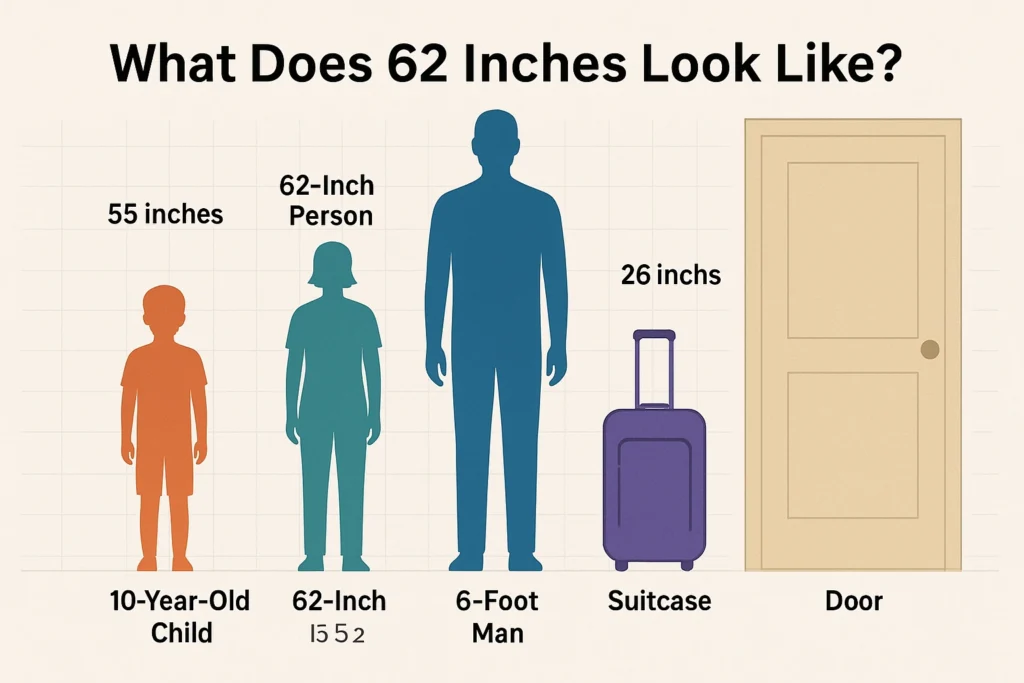
Is 62 inches tall for a 10-year-old?
Yes, it’s slightly taller than average. Most 10-year-olds are between 54 and 58 inches tall.
Is 5′2″ short for an adult?
5′2″ is shorter than the average man, but close to average for adult women.
When Numbers Fool the Eye
I once helped a friend choose a freestanding cabinet online.
It looked massive in the product photos.
The listing said “Height: 62 inches.”
She thought it would tower over her.
When it arrived, it barely reached her shoulders.
She was 5′6″. The cabinet was 5′2″.
It felt short, not tall.
That’s when we both realized visual assumptions are often wrong without scale.
Why This Matters
Whether you’re shopping, designing, or just measuring up,
knowing what 62 inches looks like is more useful than knowing what it equals.
Math gives you the number.
Your eyes give it meaning.
Ready to convert 62 inches into centimeters and compare it worldwide?
Let’s go metric next.
What Is 62 Inches in Centimeters?
Let’s convert 62 inches into centimeters.
This matters especially if you live outside the U.S. or shop from global brands.
The formula’s simple:
1 inch = 2.54 centimeters
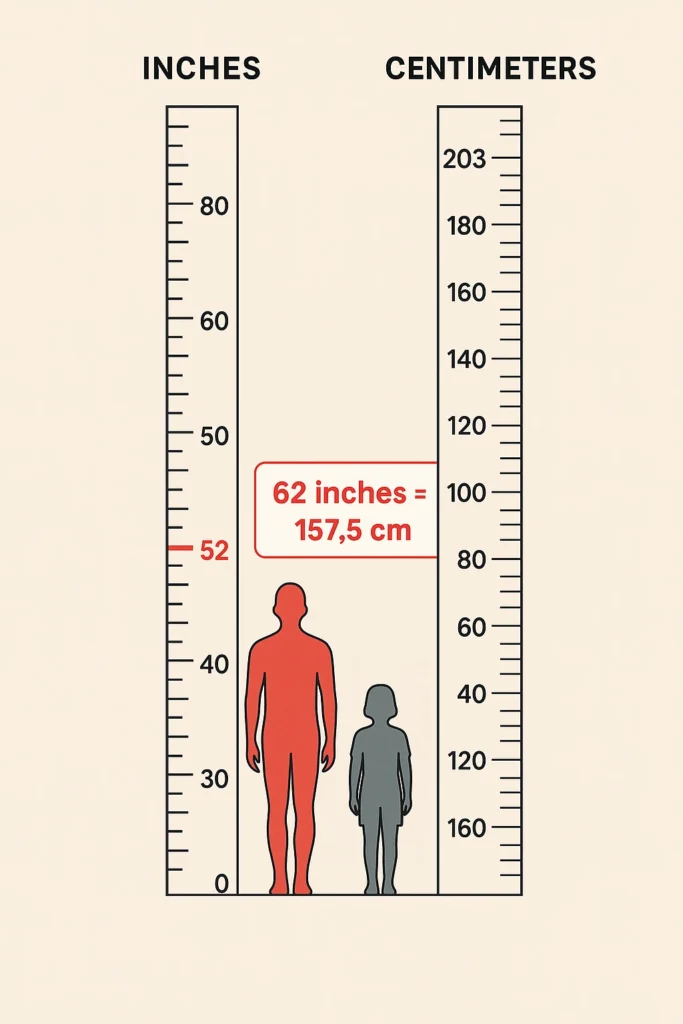
So, 62 × 2.54 = 157.48 centimeters
Rounded, that’s 157.5 cm
Quick Conversion Snapshot
62″ = 5′2″ = 157.5 cm
Why You Might Need the Metric Version
Not everyone thinks in feet and inches.
If you’re in Europe, Asia, or Canada, centimeters are standard.
Even some U.S. medical charts now list height in both systems.
Online stores often use metric too.
Ever tried buying clothes from a European site?
You’ll thank yourself for knowing your height in both.
Personal Experience: Suitcase Drama
A while ago, I bought a suitcase online.
The specs said “height: 62 cm”
I assumed that was close to 62 inches.
Wrong.
That suitcase was barely up to my knee.
It turned out to be just 24 inches tall.
That’s when I started double-checking metric conversions every time.
Metric or imperial, knowing both makes life easier.
Especially when you’re measuring, comparing, or shopping internationally.
When You Might Need to Know This
Why would I need to know what 62 inches looks like?
Numbers mean very little until you need them.
Here’s where 62 inches matters.
Buying Furniture
You see a product online.
It says “Height: 62 inches.”
Sounds tall, right?
But will it block your window?
Will it fit under a shelf?
Now you know, it’s 5′2″.
If that’s shorter than you, it’s not a wardrobe.
It’s likely a compact shelf or media stand.
Packing or Checking Luggage
Many airlines list size restrictions by inches.
I once bought a suitcase labeled “62-inch linear.”
Thought it was the height.
Wrong.
“Linear” meant height + width + depth.
And I missed the check-in limit by 3 inches.
If I had understood what 62 inches actually looks like, I wouldn’t have paid the oversize fee.
Measuring for Clothes or Costumes
Some brands list height recommendations for sizing.
“Fits children up to 62 inches.”
That’s not a guess, it’s a hard limit.
Knowing that 62 inches = 5′2″ saved me from ordering the wrong size Halloween costume for my nephew last year.
Door Frames, Closets & Clearances
A standard door is 80 inches tall.
So anything 62 inches high won’t come close.
But if you’re measuring to fit something beneath it like a mirror or cabinet you need to be sure.
I once installed a standing mirror in a closet space.
The specs read 63 inches.
The shelf above sat at 62½ inches.
Guess what? It didn’t fit.
Half an inch is enough to cost you a return.
Quote to Remember
“Measure twice. Convert once. Guess never.”
Knowing the measurement is good.
Understanding it saves time, money, and frustration.
Inches to Feet Conversion Chart
Sometimes you don’t want to calculate.
You just want to see it.
This chart covers common inch measurements around 62 inches.
Helpful when you’re comparing or visualizing nearby sizes.
| Inches | Feet & Inches |
|---|---|
| 58 | 4′10″ |
| 59 | 4′11″ |
| 60 | 5′0″ |
| 61 | 5′1″ |
| 62 | 5′2″ |
| 63 | 5′3″ |
| 64 | 5′4″ |
| 65 | 5′5″ |
| 66 | 5′6″ |
Tip for Quick Mental Math
Divide by 12 to get feet.
Multiply the leftover decimal by 12 to get inches.
That’s it.
Example:
62 ÷ 12 = 5.1666
0.1666 × 12 = 2
Result: 5 feet 2 inches
Why This Chart Helps
I’ve used charts like this on shoots and set builds.
Instead of doing math with a tape in one hand and a pencil in the other, I glance once and know.
Especially useful when you’re working in a rush.
Or when math anxiety kicks in mid-project.
Skip the calculator.
Keep this chart handy and avoid second-guessing your next measurement.